BUDO BOOK REVIEW
  • Home
  • Current and Back Issues
  • Reviews
  • Articles
  • Seminars and Events
  • Submissions
  • Contact
  • Home
  • Current and Back Issues
  • Reviews
  • Articles
  • Seminars and Events
  • Submissions
  • Contact
Search by typing & pressing enter

YOUR CART

REVIEWS

8/30/2019 0 Comments

Bokuden and the Bully

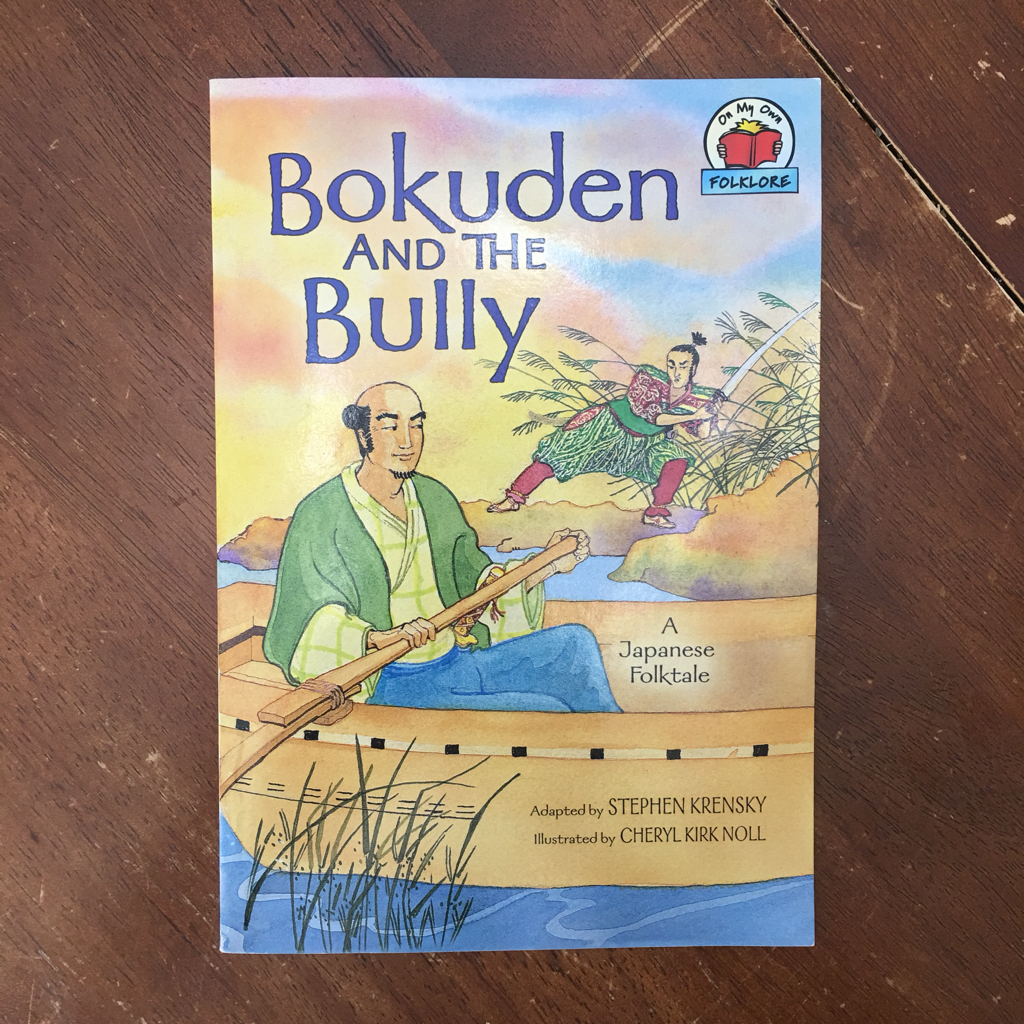
Krensky, Stephen. Illus. Noll, Cheryl Kirk. Bokuden and the Bully. Minneapolis: Millbrook Press, 2009. 48 pages.
​
ISBN 978-1-58013-847-5

​$6.95 USD 

​
​Guided Reading: N      Lexile: 400      GLE: 2-4

Picture

Folk Tale, Children’s Literature, Tsukahara Bokuden, Tenshin Shoden Katori Shinto Ryu, Kashima Shin Ryu

A boastful warrior uses his bravado to bully an old farmer and others while during a ferry crossing. With each encounter, his bragging becomes more unbelievable--and his actions more aggressive and violent. The passengers on the ferryboat will either respect him or fear him.

Except one.

A sleepy samurai, Tsukahara Bokuden, is awakened by the young warrior’s show. Despite his best efforts to explain he is not interested in a violent confrontation, Bokuden finds himself on the receiving end of a challenge to fight with sharp swords. While the bully may be stronger and faster than the men he fought in battles “too many to count,” Bokuden’s cleverness is more than a match to put this young warrior in his place.
​

The overall narrative divides into four short sections, like acts of a play, based on the setting of the action. This will help prepare young readers for tackling more-involved chapter books with chances to manage and track their place and read it over multiple sittings. If used in guided reading practice, this also give parents and teachers opportunities to have rich discussions about the plot development, predict what will happen next, and reflect on cause-and-effect.

For young readers, this work can be read alone or with help for students in second or third grades. Watercolor illustrations appear on every page to give visual clues to the content in the text. The book also contains a glossary to help with some of the more challenging or unfamiliar English words such as “ferry,” “jab,” “merchant,” and “peasant.” The use of foreign words and names is limited to Bokuden, making this work easily approachable for a wide audience while, impressively so, maintaining the critical connection of the folk tale to its Japanese roots.

If sharing this work aloud with young children, the structure and illustrations lend themselves to dramatic reading, with unique personae for each character.

At the end of the book, Krensky included an afterword. Here, he explains what a folk tale is, the role of folk tales in teaching lessons, and gives a brief account of the life and adventures of the renowned swordsman, Tsukahara Bokuden.
​

Readers can find the most important aspect of Bokuden and the Bully in the themes the book shares. Through descriptions and dialogue, Krensky reveals Bokuden as a model man of character in a dangerous age. Perhaps the best illustration of this is that, although he wears a sword, Bokuden’s greatest strengths are his humility, patience, creative thinking, and peaceful ways of handling the bully. While there are many reasons why I picked up this book, the way it delivers these critical lessons in today’s world are why it stays on my shelf.

Reviewed by Edward N. Smith, Budo Book Review


You can find Bokuden and the Bully on Amazon!
0 Comments

8/29/2019 0 Comments

Cummins, Antony & Minami, Yoshie. Samurai War Stories: Teachings and Tales Of Samurai Warfare. GLoucestershire: The History Press, 2013.

Non-fiction, history, samurai, ashigaru, women, translation
Book stores abound with romanticized ideals of the chivalrous life of samurai. Between popular and scholarly works, the lives of the elite receive significant attention in written word. Contrary to the title of the work, Samurai War Stories spends a significant portion of the book providing insights into the lives and experiences of the common footsoldier (ashigaru) and women during war in the early-modern era? Cummins’ interpretation of Minami’s translation attempts to provide glimpses into these lives and round out the military history of Japan in the Zohyo Monogatari and women in the Oan Monogatari. Not to leave the samurai absent from the work, it also includes the Musha Monogatari, a collection of lessons, memories, and anecdotes of or by important figures of the era.

Reading the seventeenth-century Zohyo Monogatari conjures images of veteran soldiers sharing their victories and shortcomings around a campfire to enlighten, educate, and frighten untested recruits. Each chapter in the two volumes begins as a soldier, defined by rank and specialization, narrates anecdotes from their military careers. Stemming from their assignments, each chapter contains insightful information stemming from the speaker’s military experience: Beyond the superficial narrative created by this structure, this work contains critical insights into the daily lives of soldiers on campaign.

Like Cummins notes in the introduction, the structure of the dialogues, topics covered, and colloquial dialogue are purposeful inclusions to enhance the character of the work (Cummins 10). This addition makes the work uniquely enjoyable to read as it stands in stark contrast to the lofty language and incredible heroics of samurai stories; these are the stories of soldiers, reminiscent of “No, shit, there I was…” sorts of narratives told over a few choice beverages.

The Musha Monogatari is a listing or retelling in brief the lives and exploits of notable samurai. In these, kernels of samurai lives, behaviors, and values. Reading more like one would expect of a samurai-centered work, the Musha Monogatari’s three sections contain lofty language, high ideals of honor and valor, and largely relate to matters of import only to samurai. As Cummins’ notes, while the details of the stories recalled may be legendary in the scale of their retelling, the kernel of truth that inspired them should inform readers of the daily concerns of the ruling military elite in the Edo Period (Cummins 11-12).

Perhaps the most interesting addition to this collection is the story of the “old nun,” (Cummins 12). The Oan Monogatari retells the sufferings of women and families escaping a castle town after a siege breaks. Though not entirely about women--or at least, not a narrative about women without samurai--this work is important in that it helps to show how the effects of samurai warfare cut across all levels of society and affected men, women, and children.

In addition, Cummins includes an historical introduction to the three works, 16 pages of illustrations in center plates, and a brief encyclopedia of biographies of the famous characters mentioned.

With nearly a dozen works to his credit, largely specializing in ninja-related matters, Cummins is one of the most prolific names in recent publication memory. According to his biographies on Watkins Publishing and in his 2011 work True Path of the Ninja, he received formal education an archaeologist with a BA and MA, the latter in neolithic archaeology. Perhaps what he is most well known for is his work establishing the Historical Ninjutsu Research Team and assisting or producing materials for film and television.

As he explains in his 2017 New Year’s video, Cummins does not speak Japanese and by his commentary, likely will not make efforts to learn the language in the future (Cummins “New Year Message”). Unfortunately, his lack of language skills stands as one of the most prominent points of contention with his works. Readers may reasonably suspect Cummins inclusion in the work of more footnotes than his previous works referencing subtleties of language may be an attempt to overcome this sticking point.

The bulk of the translation work is done by Yoshie Minami. In her author’s section in True Path of the Ninja, readers learn Minami received training in linguistics at International Christian University. Minami possesses both academic training and practical experience as a professional translator. As Cummins, on the other hand, interprets and edits the translation produced by Minami. Readers should bear this in mind when examining and evaluating the quality of the final work produced.

In as much as some of these texts have never appeared in English before, this collection is a groundbreaking publication. With a variety of tone and value of language from the highest highs to the lowest lowes of society, the work cuts an interesting slice into varied strata of Japanese history. In this work, everyone has a voice: the samurai we all read about, the gruff and unpolished common soldiers, and the women and children left in fringes yet still suffering after battle. Unfortunately, not knowing Japanese or translating himself, but rather interpreting and editing the translation of Minami brings the integrity of the translation into question. At best, this collection can serve as a springboard to further studies and, hopefully, will someday inspire a thorough, academic translation.

Reviewed by Edward N. Smith, Budo Book Review

Works Cited

Cummins, Antony. “Antony Cummins New Year Message 2017.” YouTube, uploaded by Antony Cummins, 2 January 2017, https://www.youtube.com/watch?v=hL-k5VLbN10&feature=youtu.be.

Cummins, Antony and Minami, Yoshie. True Path of the Ninja: The Definitive Translation of the Shoninki. Tokyo: Tuttle Publishing, 2011.

“Antony Cummins.” Watkins Publishing. https://www.watkinspublishing.com/authors/antony-cummins/. Accessed 8/29/2019.
0 Comments

    REVIEWS

    Budo Book Review strives to provide thoughtful, in-depth reviews of works of interest to martial artists from a variety of backgroubds.

    Archives

    July 2021
    February 2021
    August 2019

    Categories

    All Alexander Bennett Andrea Falk Antony Cummins Ashigaru Brian Gibson Budo Bushido Children's Literature China Chinese Martial Arts Dave Lowry Dojo Etiquette Folk Tales Hagakure History History Press Kashima Shin Ryu Kathryn Sparling Kendo World Literature Li Tianji Li Yukon Mishima Yukio Philosophy Samurai Taiqi Tenshin Shoden Katori Shinto Ryu Tsukahara Bokuden Volume 1 Number 1 August 2019 Volume 2 Number 1 March 2021 Weatherhill William Scott Wilson Women Wo Shu Yamamoto Tsunetomo Yoshie Minami

    RSS Feed

Powered by Create your own unique website with customizable templates.